
I finished A Christmas Carol today. I was overwhelmed by it. I have to say that the final stave was just about the happiest, infectious piece of writing I've ever read. Seeing as how I'm pressed for time, I've refrained from any discussion on the final two staves and simply wrote out the parts I found particularly touching or beautiful. I have also included the entire final stave since, as a whole, it's really fantastic.
But even here, two men who watched the light had made a fire, that through the loophole in the thick stone wall shed out a ray of brightness on the awful sea. Joining their horny hands over the rough table at which they sat, they wished each other Merry Christmas in their can of grog; and one of them: the elder, too, with his face all damaged and scarred with hard weather, as the figure-head of an old ship might be: struck up a sturdy song that was like a Gale in itself.
=======================
If you should happen, by any unlikely chance, to know a man more blest in a laugh than Scrooge’s nephew, all I can say is, I should like to know him too. Introduce him to me, and I’ll cultivate his acquaintance.
It is a fair, even-handed, noble adjustment of things, that while there is infection in disease and sorrow, there is nothing in the world so irresistibly contagious as laughter and good-humour.
=======================
“He’s a comical old fellow,” said Scrooge’s nephew, “that’s the truth: and not so pleasant as he might be. However, his offences carry their own punishment, and I have nothing to say against him.”
=======================
THE END OF IT.
Yes! and the bedpost was his own. The bed was his own, the room was his own. Best and happiest of all, the Time before him was his own, to make amends in!
“I will live in the Past, the Present, and the Future!” Scrooge repeated, as he scrambled out of bed. “The Spirits of all Three shall strive within me. Oh Jacob Marley! Heaven, and the Christmas Time be praised for this! I say it on my knees, old Jacob; on my knees!”
He was so fluttered and so glowing with his good intentions, that his broken voice would scarcely answer to his call. He had been sobbing violently in his conflict with the Spirit, and his face was wet with tears.
“They are not torn down,” cried Scrooge, folding one of his bed-curtains in his arms, “they are not torn down, rings and all. They are here—I am here—the shadows of the things that would have been, may be dispelled. They will be. I know they will!”
His hands were busy with his garments all this time; turning them inside out, putting them on upside down, tearing them, mislaying them, making them parties to every kind of extravagance.
“I don’t know what to do!” cried Scrooge, laughing and crying in the same breath; and making a perfect Laocoön of himself with his stockings. “I am as light as a feather, I am as happy as an angel, I am as merry as a schoolboy. I am as giddy as a drunken man. A merry Christmas to everybody! A happy New Year to all the world. Hallo here! Whoop! Hallo!”
He had frisked into the sitting-room, and was now standing there: perfectly winded.
“There’s the saucepan that the gruel was in!” cried Scrooge, starting off again, and going round the fireplace. “There’s the door, by which the Ghost of Jacob Marley entered! There’s the corner where the Ghost of Christmas Present, sat! There’s the window where I saw the wandering Spirits! It’s all right, it’s all true, it all happened. Ha ha ha!”
Really, for a man who had been out of practice for so many years, it was a splendid laugh, a most illustrious laugh. The father of a long, long line of brilliant laughs!
“I don’t know what day of the month it is!” said Scrooge. “I don’t know how long I’ve been among the Spirits. I don’t know anything. I’m quite a baby. Never mind. I don’t care. I’d rather be a baby. Hallo! Whoop! Hallo here!”
He was checked in his transports by the churches ringing out the lustiest peals he had ever heard. Clash, clang, hammer; ding, dong, bell. Bell, dong, ding; hammer, clang, clash! Oh, glorious, glorious!
Running to the window, he opened it, and put out his head. No fog, no mist; clear, bright, jovial, stirring, cold; cold, piping for the blood to dance to; Golden sunlight; Heavenly sky; sweet fresh air; merry bells. Oh, glorious! Glorious!
“What’s to-day!” cried Scrooge, calling downward to a boy in Sunday clothes, who perhaps had loitered in to look about him.
“Eh?” returned the boy, with all his might of wonder.
“What’s to-day, my fine fellow?” said Scrooge.
“To-day!” replied the boy. “Why, Christmas Day.”
“It’s Christmas Day!” said Scrooge to himself. “I haven’t missed it. The Spirits have done it all in one night. They can do anything they like. Of course they can. Of course they can. Hallo, my fine fellow!”
“Hallo!” returned the boy.
“Do you know the Poulterer’s, in the next street but one, at the corner?” Scrooge inquired.
“I should hope I did,” replied the lad.
“An intelligent boy!” said Scrooge. “A remarkable boy! Do you know whether they’ve sold the prize Turkey that was hanging up there?—Not the little prize Turkey: the big one?”
“What, the one as big as me?” returned the boy.
“What a delightful boy!” said Scrooge. “It’s a pleasure to talk to him. Yes, my buck!”
“It’s hanging there now,” replied the boy.
“Is it?” said Scrooge. “Go and buy it.”
“Walk-er!” exclaimed the boy.
“No, no,” said Scrooge, “I am in earnest. Go and buy it, and tell ’em to bring it here, that I may give them the direction where to take it. Come back with the man, and I’ll give you a shilling. Come back with him in less than five minutes and I’ll give you half-a-crown!”
The boy was off like a shot. He must have had a steady hand at a trigger who could have got a shot off half so fast.
“I’ll send it to Bob Cratchit’s!” whispered Scrooge, rubbing his hands, and splitting with a laugh. “He sha’n’t know who sends it. It’s twice the size of Tiny Tim. Joe Miller never made such a joke as sending it to Bob’s will be!”
The hand in which he wrote the address was not a steady one, but write it he did, somehow, and went down-stairs to open the street door, ready for the coming of the poulterer’s man. As he stood there, waiting his arrival, the knocker caught his eye.
“I shall love it, as long as I live!” cried Scrooge, patting it with his hand. “I scarcely ever looked at it before. What an honest expression it has in its face! It’s a wonderful knocker!—Here’s the Turkey! Hallo! Whoop! How are you! Merry Christmas!”
It was a Turkey! He never could have stood upon his legs, that bird. He would have snapped ’em short off in a minute, like sticks of sealing-wax.
“Why, it’s impossible to carry that to Camden Town,” said Scrooge. “You must have a cab.”
The chuckle with which he said this, and the chuckle with which he paid for the Turkey, and the chuckle with which he paid for the cab, and the chuckle with which he recompensed the boy, were only to be exceeded by the chuckle with which he sat down breathless in his chair again, and chuckled till he cried.
Shaving was not an easy task, for his hand continued to shake very much; and shaving requires attention, even when you don’t dance while you are at it. But if he had cut the end of his nose off, he would have put a piece of sticking-plaister over it, and been quite satisfied.
He dressed himself “all in his best,” and at last got out into the streets. The people were by this time pouring forth, as he had seen them with the Ghost of Christmas Present; and walking with his hands behind him, Scrooge regarded every one with a delighted smile. He looked so irresistibly pleasant, in a word, that three or four good-humoured fellows said, “Good morning, sir! A merry Christmas to you!” And Scrooge said often afterwards, that of all the blithe sounds he had ever heard, those were the blithest in his ears.
He had not gone far, when coming on towards him he beheld the portly gentleman, who had walked into his counting-house the day before, and said, “Scrooge and Marley’s, I believe?” It sent a pang across his heart to think how this old gentleman would look upon him when they met; but he knew what path lay straight before him, and he took it.
“My dear sir,” said Scrooge, quickening his pace, and taking the old gentleman by both his hands. “How do you do? I hope you succeeded yesterday. It was very kind of you. A merry Christmas to you, sir!”
“Mr. Scrooge?”
“Yes,” said Scrooge. “That is my name, and I fear it may not be pleasant to you. Allow me to ask your pardon. And will you have the goodness”—here Scrooge whispered in his ear.
“Lord bless me!” cried the gentleman, as if his breath were taken away. “My dear Mr. Scrooge, are you serious?”
“If you please,” said Scrooge. “Not a farthing less. A great many back-payments are included in it, I assure you. Will you do me that favour?”
“My dear sir,” said the other, shaking hands with him. “I don’t know what to say to such munifi—”
“Don’t say anything, please,” retorted Scrooge. “Come and see me. Will you come and see me?”
“I will!” cried the old gentleman. And it was clear he meant to do it.
“Thank’ee,” said Scrooge. “I am much obliged to you. I thank you fifty times. Bless you!”
He went to church, and walked about the streets, and watched the people hurrying to and fro, and patted children on the head, and questioned beggars, and looked down into the kitchens of houses, and up to the windows, and found that everything could yield him pleasure. He had never dreamed that any walk—that anything—could give him so much happiness. In the afternoon he turned his steps towards his nephew’s house.
He passed the door a dozen times, before he had the courage to go up and knock. But he made a dash, and did it:
“Is your master at home, my dear?” said Scrooge to the girl. Nice girl! Very.
“Yes, sir.”
“Where is he, my love?” said Scrooge.
“He’s in the dining-room, sir, along with mistress. I’ll show you up-stairs, if you please.”
“Thank’ee. He knows me,” said Scrooge, with his hand already on the dining-room lock. “I’ll go in here, my dear.”
He turned it gently, and sidled his face in, round the door. They were looking at the table (which was spread out in great array); for these young housekeepers are always nervous on such points, and like to see that everything is right.
“Fred!” said Scrooge.
Dear heart alive, how his niece by marriage started! Scrooge had forgotten, for the moment, about her sitting in the corner with the footstool, or he wouldn’t have done it, on any account.
“Why bless my soul!” cried Fred, “who’s that?”
“It’s I. Your uncle Scrooge. I have come to dinner. Will you let me in, Fred?”
Let him in! It is a mercy he didn’t shake his arm off. He was at home in five minutes. Nothing could be heartier. His niece looked just the same. So did Topper when he came. So did the plump sister when she came. So did every one when they came. Wonderful party, wonderful games, wonderful unanimity, won-der-ful happiness!
But he was early at the office next morning. Oh, he was early there. If he could only be there first, and catch Bob Cratchit coming late! That was the thing he had set his heart upon.
And he did it; yes, he did! The clock struck nine. No Bob. A quarter past. No Bob. He was full eighteen minutes and a half behind his time. Scrooge sat with his door wide open, that he might see him come into the Tank.
His hat was off, before he opened the door; his comforter too. He was on his stool in a jiffy; driving away with his pen, as if he were trying to overtake nine o’clock.
“Hallo!” growled Scrooge, in his accustomed voice, as near as he could feign it. “What do you mean by coming here at this time of day?”
“I am very sorry, sir,” said Bob. “I am behind my time.”
“You are?” repeated Scrooge. “Yes. I think you are. Step this way, sir, if you please.”
“It’s only once a year, sir,” pleaded Bob, appearing from the Tank. “It shall not be repeated. I was making rather merry yesterday, sir.”
“Now, I’ll tell you what, my friend,” said Scrooge, “I am not going to stand this sort of thing any longer. And therefore,” he continued, leaping from his stool, and giving Bob such a dig in the waistcoat that he staggered back into the Tank again; “and therefore I am about to raise your salary!”
Bob trembled, and got a little nearer to the ruler. He had a momentary idea of knocking Scrooge down with it, holding him, and calling to the people in the court for help and a strait-waistcoat.
“A merry Christmas, Bob!” said Scrooge, with an earnestness that could not be mistaken, as he clapped him on the back. “A merrier Christmas, Bob, my good fellow, than I have given you, for many a year! I’ll raise your salary, and endeavour to assist your struggling family, and we will discuss your affairs this very afternoon, over a Christmas bowl of smoking bishop, Bob! Make up the fires, and buy another coal-scuttle before you dot another i, Bob Cratchit!”
Scrooge was better than his word. He did it all, and infinitely more; and to Tiny Tim, who did not die, he was a second father. He became as good a friend, as good a master, and as good a man, as the good old city knew, or any other good old city, town, or borough, in the good old world. Some people laughed to see the alteration in him, but he let them laugh, and little heeded them; for he was wise enough to know that nothing ever happened on this globe, for good, at which some people did not have their fill of laughter in the outset; and knowing that such as these would be blind anyway, he thought it quite as well that they should wrinkle up their eyes in grins, as have the malady in less attractive forms. His own heart laughed: and that was quite enough for him.
He had no further intercourse with Spirits, but lived upon the Total Abstinence Principle, ever afterwards; and it was always said of him, that he knew how to keep Christmas well, if any man alive possessed the knowledge. May that be truly said of us, and all of us! And so, as Tiny Tim observed, God bless Us, Every One!
Showing posts with label Charles Dickens. Show all posts
Showing posts with label Charles Dickens. Show all posts
Monday, January 7, 2008


Wednesday, December 19, 2007
The Ghost of Christmas Present
Something I noticed while reading Stave III was the difference between the Ghost of Christmas Past and Ghost of Christmas Present. The Ghost of Christmas past was both young and old. As I said, it seemed to be an indication of how the past was once new, but is now old to us. The Ghost of Christmas Present, however, is a young, bearded man, bare-chested and joyful. There is no age mingled into his appearance, indicating that time has not yet had any effect on him. I think he is portrayed as the most jolly of the spirits because he is indicative of how we feel in the present. In the present, there is all the hope that none of the sorrows of the past will effect us again, while at the same time there is the ignorance of anything tragic in the future. The present is about as happy as we can possibly be, which is why this particular ghost is so youthful and why his entourage consists of festive foods, drink, warmth, fire, and greenery. There is also the obvious reflection that Christmas Present is a newborn holiday full of potential and the promise of new life. Christmas Present makes us feel young. Something that is extraordinarily poignant about this spirit, however, is that, with all the pomp and circumstance with which it appears to Scrooge, in reality it is not primarily the reflection of the outward festivity of Christmas. The visions that the spirit shows to Scrooge are not all of the wealthy enjoying the rich food and drink of the holiday. Truly, the spirit shows to Scrooge visions of even the poorest of the poor gorging themselves on the joy and festive spirit of Christmas. Thusly, this spirit is symbolic of how Christmas makes us feel, rather than the gifts, food, drink, singing, and celebration that ensue. The spirit is merely significant of a generosity of soul, and while merely is a far from accurate description of his connotations, it is as simply beautiful as Dickens could have made it.
 The Ghost of Christmas past was both young and old. As I said, it seemed to be an indication of how the past was once new, but is now old to us. The Ghost of Christmas Present, however, is a young, bearded man, bare-chested and joyful. There is no age mingled into his appearance, indicating that time has not yet had any effect on him. I think he is portrayed as the most jolly of the spirits because he is indicative of how we feel in the present. In the present, there is all the hope that none of the sorrows of the past will effect us again, while at the same time there is the ignorance of anything tragic in the future. The present is about as happy as we can possibly be, which is why this particular ghost is so youthful and why his entourage consists of festive foods, drink, warmth, fire, and greenery. There is also the obvious reflection that Christmas Present is a newborn holiday full of potential and the promise of new life. Christmas Present makes us feel young. Something that is extraordinarily poignant about this spirit, however, is that, with all the pomp and circumstance with which it appears to Scrooge, in reality it is not primarily the reflection of the outward festivity of Christmas. The visions that the spirit shows to Scrooge are not all of the wealthy enjoying the rich food and drink of the holiday. Truly, the spirit shows to Scrooge visions of even the poorest of the poor gorging themselves on the joy and festive spirit of Christmas. Thusly, this spirit is symbolic of how Christmas makes us feel, rather than the gifts, food, drink, singing, and celebration that ensue. The spirit is merely significant of a generosity of soul, and while merely is a far from accurate description of his connotations, it is as simply beautiful as Dickens could have made it.
Tuesday, December 18, 2007
A Christmas Carol Reading: Stave II continued...
Something I found myself asking while I read Stave II was as follows: Exactly where did Scrooge go wrong? Dickens takes us from Scrooge as a lonely boy, to Scrooge as a young man working for Mr. Fezziwig. In both these instances, there is no real foreshadowing of the bitter old man he is going to become. The first time that we see the beginnings of the "Scrooge" we all know and avoid is when we first meet Belle. There is a giant gap in between and there is no explanation for why Scrooge has become the way he has. The gap is as such: we have a memory of Scrooge and Dick singing Fezziwig's praises for his generosity at Christmastime and they are both (yes, Scrooge included) having a wonderful time at the Christmas party. No hateful Scrooge here. Then, the memory to follow suddenly presents us with a cold-hearted Scrooge rejecting the love of his former sweetheart, Belle, because he has become greedy and obsessed with his work. Very little transition.
Is this bad writing, or is Dicken's leaving out so much information in order to highlight that mysterious point in Scrooge's life? The Mona Lisa by Da Vinci is considered one of the greatest but also most mysterious works of art. It isn't just the famous smile that makes her so mysterious, there is also a gap between one side of the canvas to the other. To the right of her head there is a towering landcape, well above the viewer's "horizon" line, to the left of her head the landscape becomes flat plains, equal the viewer's horizon. It is behind her head, the one place we can't see, that the transition occurrs. Is there a waterfall? Are they merely cliffs? Is there a chasm in between? We cannot tell, and will never know exactly what Da Vinci saw behind the lady's cryptic face. That is part of the mystery, and we can be sure that it wasn't an accident. I think there is something similar going on in Stave II.
Dickens is a master. We could only hope to learn half of what he knew about the art of story-telling. I do not think it was an accident that he leaves no explanation or giant event that caused Scrooge's transformation.
I think Da Vinci hid the secret of the landscape because he wanted people to think...to imagine or create their own landscape based on the information he gave them, even if the conclusions where not what he himself had imagined. It was his own little literary twist in the painting, because what literature is, first and foremost, is an outlet for the imagination. There are no set interpretations for everything, and in many cases we must imagine or invent exanations for otherwise unexplained events.
In the case of Scrooge, I think the hidden transformation is the arrival of Marley. We do not hear of him at all during Stave II until we see Belle for the second time. This memory follows that of Belle leaving Scrooge. She is settled with children and a husband. Her husband comes in and tells her he's "seen an old friend" of hers, Scrooge, sitting alone at his books on Christmas Eve. He then says, "his partner lies upon the point of death." This is the first mention of Marley. I think the fact that he isn't mentioned up to this point makes his presence more apparent. Scrooge changes because of Marley. He becomes involved in the partnership and inevitably begins to become like Marley. A rotten apple makes the good apple rotten, not vice versa. Belle was the last thing trying to hold onto the young Scrooge before he became Marley completely. We remember in Stave I that Scrooge answer to both Scrooge and Marley. There is nothing but a corporeal difference between the two men. They are both rotten and apathetic to the world and its suffering. I think that transformation of Scrooge is finalized by the death of Marley. As Belle's husband says, on Christmas Eve Scrooge sits at his books, his partner on the verge of death. When Marley dies, we could conclude that Scrooge has finally, completely become Marley. Marley leaves the world, but his legacy continues.
Something I did notice was the so-called "twitch upon the thread"; that small something that reminds a person of what they should be, or of what is right. It is when Scrooge sees the memory of his little sister. She is full of life and joy for Christmas and has died, we do not know how, but only that she was always frail. She dies leaving behind one child, Scrooge's nephew. He feels a pang of guilt for turning away his nephew earlier. The nephew has the same enthusiasm and heart of gold that his mother had. When he sees his sister he remebers how he loved her and regrets that he hasn't loved his nephew in the same way.
I'm all talked out now but I think that's enough for Stave II. I'm going to move on to Stave III today and hopefully I'll have a post by tomorrow.
Is this bad writing, or is Dicken's leaving out so much information in order to highlight that mysterious point in Scrooge's life? The Mona Lisa by Da Vinci is considered one of the greatest but also most mysterious works of art. It isn't just the famous smile that makes her so mysterious, there is also a gap between one side of the canvas to the other. To the right of her head there is a towering landcape, well above the viewer's "horizon" line, to the left of her head the landscape becomes flat plains, equal the viewer's horizon. It is behind her head, the one place we can't see, that the transition occurrs. Is there a waterfall? Are they merely cliffs? Is there a chasm in between? We cannot tell, and will never know exactly what Da Vinci saw behind the lady's cryptic face. That is part of the mystery, and we can be sure that it wasn't an accident. I think there is something similar going on in Stave II.
Dickens is a master. We could only hope to learn half of what he knew about the art of story-telling. I do not think it was an accident that he leaves no explanation or giant event that caused Scrooge's transformation.
I think Da Vinci hid the secret of the landscape because he wanted people to think...to imagine or create their own landscape based on the information he gave them, even if the conclusions where not what he himself had imagined. It was his own little literary twist in the painting, because what literature is, first and foremost, is an outlet for the imagination. There are no set interpretations for everything, and in many cases we must imagine or invent exanations for otherwise unexplained events.
In the case of Scrooge, I think the hidden transformation is the arrival of Marley. We do not hear of him at all during Stave II until we see Belle for the second time. This memory follows that of Belle leaving Scrooge. She is settled with children and a husband. Her husband comes in and tells her he's "seen an old friend" of hers, Scrooge, sitting alone at his books on Christmas Eve. He then says, "his partner lies upon the point of death." This is the first mention of Marley. I think the fact that he isn't mentioned up to this point makes his presence more apparent. Scrooge changes because of Marley. He becomes involved in the partnership and inevitably begins to become like Marley. A rotten apple makes the good apple rotten, not vice versa. Belle was the last thing trying to hold onto the young Scrooge before he became Marley completely. We remember in Stave I that Scrooge answer to both Scrooge and Marley. There is nothing but a corporeal difference between the two men. They are both rotten and apathetic to the world and its suffering. I think that transformation of Scrooge is finalized by the death of Marley. As Belle's husband says, on Christmas Eve Scrooge sits at his books, his partner on the verge of death. When Marley dies, we could conclude that Scrooge has finally, completely become Marley. Marley leaves the world, but his legacy continues.
Something I did notice was the so-called "twitch upon the thread"; that small something that reminds a person of what they should be, or of what is right. It is when Scrooge sees the memory of his little sister. She is full of life and joy for Christmas and has died, we do not know how, but only that she was always frail. She dies leaving behind one child, Scrooge's nephew. He feels a pang of guilt for turning away his nephew earlier. The nephew has the same enthusiasm and heart of gold that his mother had. When he sees his sister he remebers how he loved her and regrets that he hasn't loved his nephew in the same way.
I'm all talked out now but I think that's enough for Stave II. I'm going to move on to Stave III today and hopefully I'll have a post by tomorrow.
Friday, December 7, 2007
Stave 1: A Christmas Carol
Dickens has such a way of writing a first sentence--a first paragraph even. "Marley was dead, to begin with" is just another example. It sucks you in immediately. You think "oo deat h!" and he's got you. I have to confess I've never read A Christmas Carol before this and I think somewhere it says I should be tarred and feathered for this terrible truth. As I sat reading Stave 1, drinking all-too-strong coffee and feeling the winter chill in my bones, I discovered that I'm absolutely crazy about everything Dickens. I have several examples of why I came to this revelation, among them being comments on the style, tone, and especially some of the barely perceptible little devices Dickens uses to make the story more interesting and even believable.
I think many people criticize Dickens for his style. Not in the way you might think of criticism. Most people will say "I think Dickens is an absolute genius but I simply couldn't make it through A Tale of Two Cities what with all the detours and passages describing things." I believe I've heard it put that way precisely. However, that is exactly why I'm so wild about Dickens. Following is merely one line from his description of Scrooge that I found particularly vivid and effective:
Hard and sharp as flint, from which no steel had ever struck out generous fire.
Not only is it extraordinarily poetic for prose, the sentiment is wildly meaningful. Dickens takes the coldest, most gritty and unamicable stone you can think of and describes it as a more generous entity than his protagonist. This one phrase alone lets you know exactly what kind of man Scrooge is. But D doesn't stop there. He puts Scrooge outside of time, outside of this world, in a sense, detailing him as though he stands apart from this reality, giving no emotion to the world and accepting none in turn. He carries his cold with him. As D says:
External heat and cold had little influence on Scrooge. No warmth could warm, no wintry weather chill him. No wind that blew was bitterer than he, no falling snow was more intent upon its purpose, no pelting rain less open to entreaty. Foul weather didn’t know where to have him. The heaviest rain, and snow, and hail, and sleet, could boast of the advantage over him in only one respect. They often “came down” handsomely, and Scrooge never did.
He is touched by nothing, even nature itself has no power to move him. And again, comparing Scrooge to rain, snow, hail and sleet, Dickens lets us know that even these are more generous.
Something else I noticed while reading Stave 1 was the way that Christmas is portrayed. In as much as Dickens portrays Scrooge as being outside of this reality in a harsh, ungiving manner, he portrays Christmas as being outside of and unaffected by anything worldly in the most poignant, joyful manner. Comments made throughout the stave indicate that Christmas makes time stop, and instead of being affected by people, people take on the essence of Christmas. We see this most vividly in the case of Scrooge's nephew, whose character, it seems, is primarily meant to be the most sharp, meaningful contrast to Scrooge as hot is to cold and black is to white. As the nephew says of Christmas:
(It is) the only time I know of, in the long calendar of the year, when men and women seem by one consent to open their shut-up hearts freely, and to think of people below them as if they really were fellow-passengers to the grave, and not another race of creatures bound on other journeys. And therefore, uncle, though it has never put a scrap of gold or silver in my pocket, I believe that it has done me good, and will do me good; and I say, God bless it!
This childlike love and joy for Christmas recurs frequently. It's all part of illustrating exactly how strange Scrooge is to be untouched by the season. Dickens describes how everyone, from the poorest of the poor to the Lord Mayor himself, celebrate the holy day. The Mayor encourages everyone to celebrate: "Even the little tailor, whom he had fined for being drunk and bloodthirsty in the streets, stirred up tomorrow's pudding in his garret." The image presented is humorous. The adjective "little" is amusingly contrasted to "drunk and bloodthirsty" causing us to think more of a misbehaving child than a "criminal." But we might conclude that Christmas has that effect on people. In the case of Bob Cratchett, who has, in Stave 1, remained unnamed, we see this as well. Dickens initially presents him as a shivering, miserable employee, then, the moment that Cratchett is set free for the holiday, he becomes a new man:
The office was closed in a twinkling, and the clerk, with the long ends of his white comforter dangling below his waist (for he boasted no great-coat), went down a slide on Cornhill, at the end of a lane of boys, twenty-times in honor of its being Christmas Eve, and then ran home to Camden Town as hard as he could pelt, to play at blindman's bluff.
Is this the unhappy clerk, or a child he is describing? Both, which is why it's so moving.
An interesting note: after the nephew's exuberant speech about Christmas, Bob Cratchett (The clerk) applauds out of sheer engrossment. Remembering Scrooge, and "becoming immediately sensible of the impropriety, he poked the fire, and extinguished the last frail spark for ever." I think this sentence has a bit more meaning, and I think Dickens intended it to. Does the word "fire" actually mean the fire in the grate, and did Bob Cratchett put it out, or did someone else?
Talk amongst yeh-selves.
Finally, Dickens sets the table for the coming of the three ghosts. Leading up to Marley's appearance, Dickens has made a connection between Scrooge and Marley. They were partners, and over the years seemed to have merged as one. People call Scrooge Scrooge, and sometimes Marley, but he answers to both. I think this make the fact that Marley is dead quite significant beyond the ghostly apparition factor. It also makes the point that Scrooge is half dead. The dead Marley, to me, appears significant as the dead inside of Scrooge, the chill that moves with him. The appearance of Marley seems to make Scrooge partially aware of this, though it is only the beginning. Marley's dialogue also makes it clear to us that Scrooge isn't even an unbeliever. Were he merely a materialist, or an atheist, or agnostic, he would simply not believe in what he cannot see, touch, taste, and hear. However, when Marley appears, Scrooge argues with the apparition as to whether he is a reality or not. Marley asks him, "Why do you doubt your senses," essentially, "Why do you not believe what you are seeing, hearing, and feeling?" But Scrooge chalks the ghost up to being indigestion. He literally betrays his own senses, and is left with absolutely nothing to believe in. He is as empty as a dry cask. But Marley further illustrates the death within Scrooge: "I have sat invisible beside you many and many a day." Marley is present at all times with Scrooge, as who he is, as a reminder of what he will become, and as a warning to change or suffer the fate of many. When Marley leaves, we get a glimpse of the purgatorial afterlife. Hundreds of ghosts chasing about the world, longing to help those they did not regard in life, yearning for rest and peace but denied it:
The misery with them all was, clearly, that they sought to interfere, for good, in human matters, and had lost the power forever.
There is no rest for the weary.
A note to any readers: If you disagree or have an interesting comment, shout it out! I love a good conversation.
 h!" and he's got you. I have to confess I've never read A Christmas Carol before this and I think somewhere it says I should be tarred and feathered for this terrible truth. As I sat reading Stave 1, drinking all-too-strong coffee and feeling the winter chill in my bones, I discovered that I'm absolutely crazy about everything Dickens. I have several examples of why I came to this revelation, among them being comments on the style, tone, and especially some of the barely perceptible little devices Dickens uses to make the story more interesting and even believable.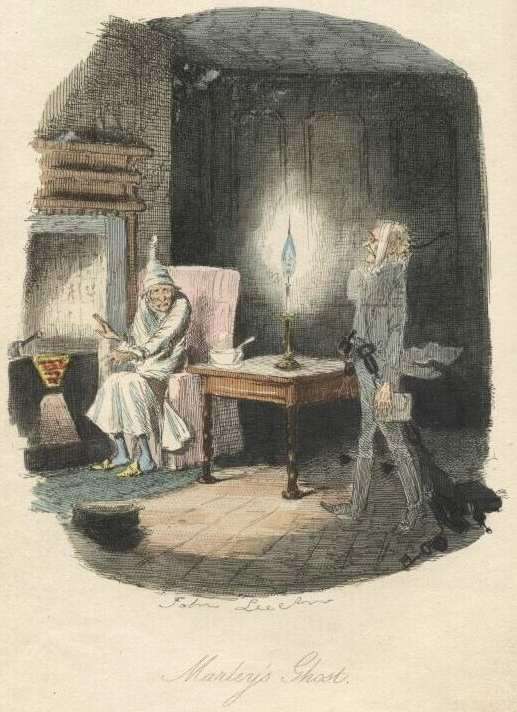
I think many people criticize Dickens for his style. Not in the way you might think of criticism. Most people will say "I think Dickens is an absolute genius but I simply couldn't make it through A Tale of Two Cities what with all the detours and passages describing things." I believe I've heard it put that way precisely. However, that is exactly why I'm so wild about Dickens. Following is merely one line from his description of Scrooge that I found particularly vivid and effective:
Hard and sharp as flint, from which no steel had ever struck out generous fire.
Not only is it extraordinarily poetic for prose, the sentiment is wildly meaningful. Dickens takes the coldest, most gritty and unamicable stone you can think of and describes it as a more generous entity than his protagonist. This one phrase alone lets you know exactly what kind of man Scrooge is. But D doesn't stop there. He puts Scrooge outside of time, outside of this world, in a sense, detailing him as though he stands apart from this reality, giving no emotion to the world and accepting none in turn. He carries his cold with him. As D says:
External heat and cold had little influence on Scrooge. No warmth could warm, no wintry weather chill him. No wind that blew was bitterer than he, no falling snow was more intent upon its purpose, no pelting rain less open to entreaty. Foul weather didn’t know where to have him. The heaviest rain, and snow, and hail, and sleet, could boast of the advantage over him in only one respect. They often “came down” handsomely, and Scrooge never did.
He is touched by nothing, even nature itself has no power to move him. And again, comparing Scrooge to rain, snow, hail and sleet, Dickens lets us know that even these are more generous.
Something else I noticed while reading Stave 1 was the way that Christmas is portrayed. In as much as Dickens portrays Scrooge as being outside of this reality in a harsh, ungiving manner, he portrays Christmas as being outside of and unaffected by anything worldly in the most poignant, joyful manner. Comments made throughout the stave indicate that Christmas makes time stop, and instead of being affected by people, people take on the essence of Christmas. We see this most vividly in the case of Scrooge's nephew, whose character, it seems, is primarily meant to be the most sharp, meaningful contrast to Scrooge as hot is to cold and black is to white. As the nephew says of Christmas:
(It is) the only time I know of, in the long calendar of the year, when men and women seem by one consent to open their shut-up hearts freely, and to think of people below them as if they really were fellow-passengers to the grave, and not another race of creatures bound on other journeys. And therefore, uncle, though it has never put a scrap of gold or silver in my pocket, I believe that it has done me good, and will do me good; and I say, God bless it!
This childlike love and joy for Christmas recurs frequently. It's all part of illustrating exactly how strange Scrooge is to be untouched by the season. Dickens describes how everyone, from the poorest of the poor to the Lord Mayor himself, celebrate the holy day. The Mayor encourages everyone to celebrate: "Even the little tailor, whom he had fined for being drunk and bloodthirsty in the streets, stirred up tomorrow's pudding in his garret." The image presented is humorous. The adjective "little" is amusingly contrasted to "drunk and bloodthirsty" causing us to think more of a misbehaving child than a "criminal." But we might conclude that Christmas has that effect on people. In the case of Bob Cratchett, who has, in Stave 1, remained unnamed, we see this as well. Dickens initially presents him as a shivering, miserable employee, then, the moment that Cratchett is set free for the holiday, he becomes a new man:
The office was closed in a twinkling, and the clerk, with the long ends of his white comforter dangling below his waist (for he boasted no great-coat), went down a slide on Cornhill, at the end of a lane of boys, twenty-times in honor of its being Christmas Eve, and then ran home to Camden Town as hard as he could pelt, to play at blindman's bluff.
Is this the unhappy clerk, or a child he is describing? Both, which is why it's so moving.
An interesting note: after the nephew's exuberant speech about Christmas, Bob Cratchett (The clerk) applauds out of sheer engrossment. Remembering Scrooge, and "becoming immediately sensible of the impropriety, he poked the fire, and extinguished the last frail spark for ever." I think this sentence has a bit more meaning, and I think Dickens intended it to. Does the word "fire" actually mean the fire in the grate, and did Bob Cratchett put it out, or did someone else?
Talk amongst yeh-selves.
Finally, Dickens sets the table for the coming of the three ghosts. Leading up to Marley's appearance, Dickens has made a connection between Scrooge and Marley. They were partners, and over the years seemed to have merged as one. People call Scrooge Scrooge, and sometimes Marley, but he answers to both. I think this make the fact that Marley is dead quite significant beyond the ghostly apparition factor. It also makes the point that Scrooge is half dead. The dead Marley, to me, appears significant as the dead inside of Scrooge, the chill that moves with him. The appearance of Marley seems to make Scrooge partially aware of this, though it is only the beginning. Marley's dialogue also makes it clear to us that Scrooge isn't even an unbeliever. Were he merely a materialist, or an atheist, or agnostic, he would simply not believe in what he cannot see, touch, taste, and hear. However, when Marley appears, Scrooge argues with the apparition as to whether he is a reality or not. Marley asks him, "Why do you doubt your senses," essentially, "Why do you not believe what you are seeing, hearing, and feeling?" But Scrooge chalks the ghost up to being indigestion. He literally betrays his own senses, and is left with absolutely nothing to believe in. He is as empty as a dry cask. But Marley further illustrates the death within Scrooge: "I have sat invisible beside you many and many a day." Marley is present at all times with Scrooge, as who he is, as a reminder of what he will become, and as a warning to change or suffer the fate of many. When Marley leaves, we get a glimpse of the purgatorial afterlife. Hundreds of ghosts chasing about the world, longing to help those they did not regard in life, yearning for rest and peace but denied it:
The misery with them all was, clearly, that they sought to interfere, for good, in human matters, and had lost the power forever.
There is no rest for the weary.
A note to any readers: If you disagree or have an interesting comment, shout it out! I love a good conversation.
Subscribe to:
Posts (Atom)